Difference Between mg and mL: Mass, Volume, and Medicine Explained
Understand the difference between milligrams and milliliters, how density and concentration connect them, and why medicine labels often use both units for different purposes.
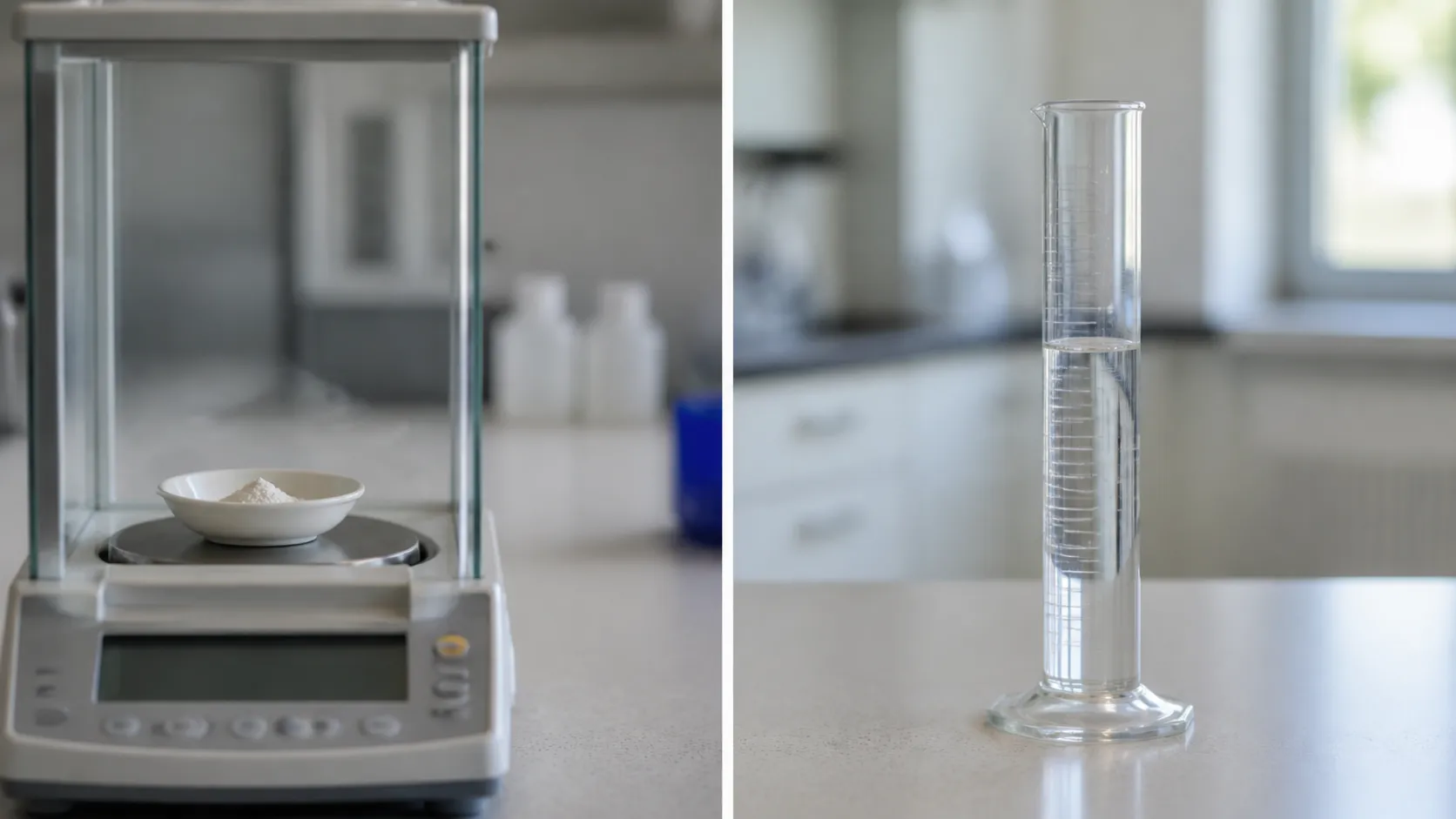
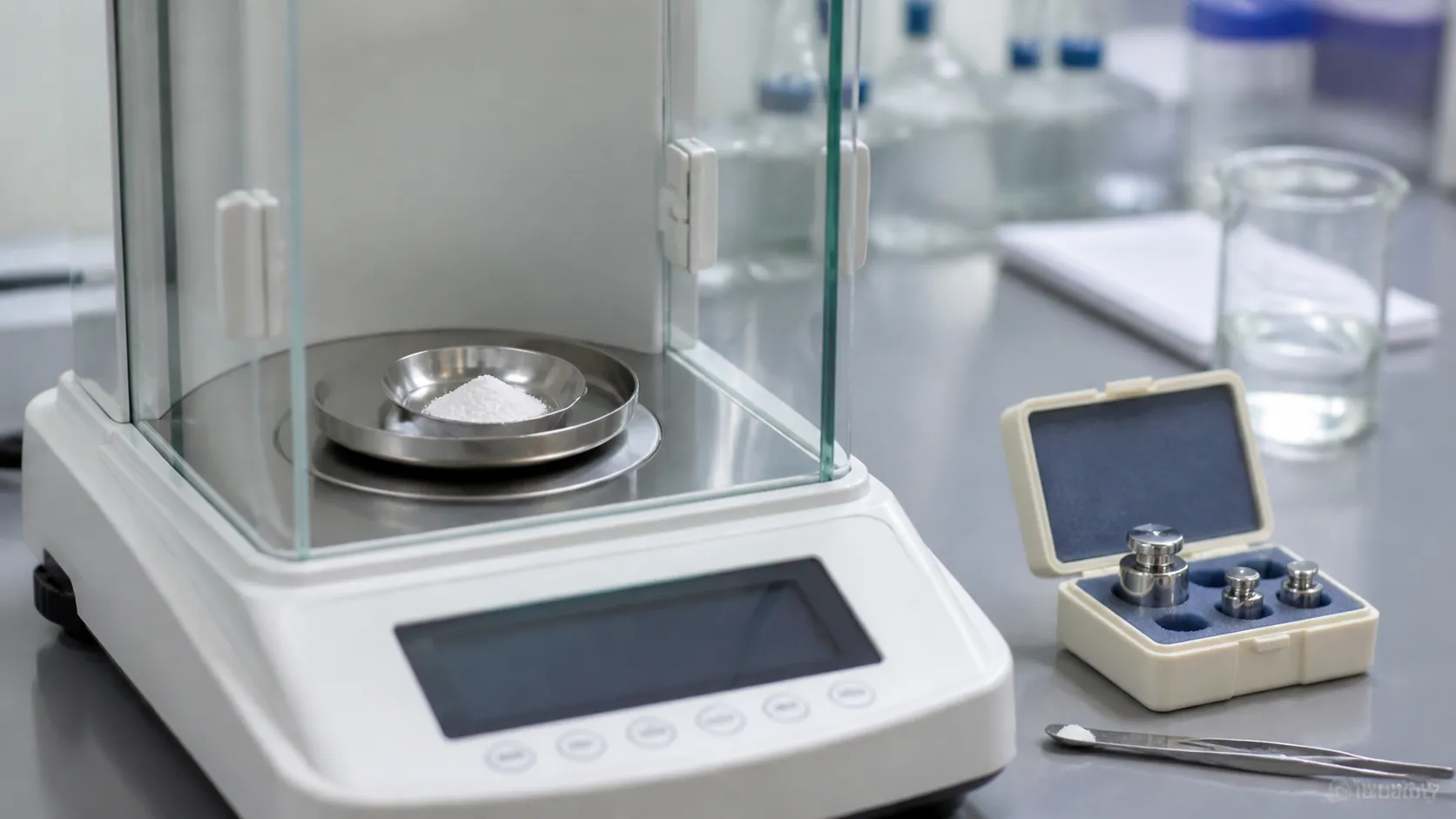
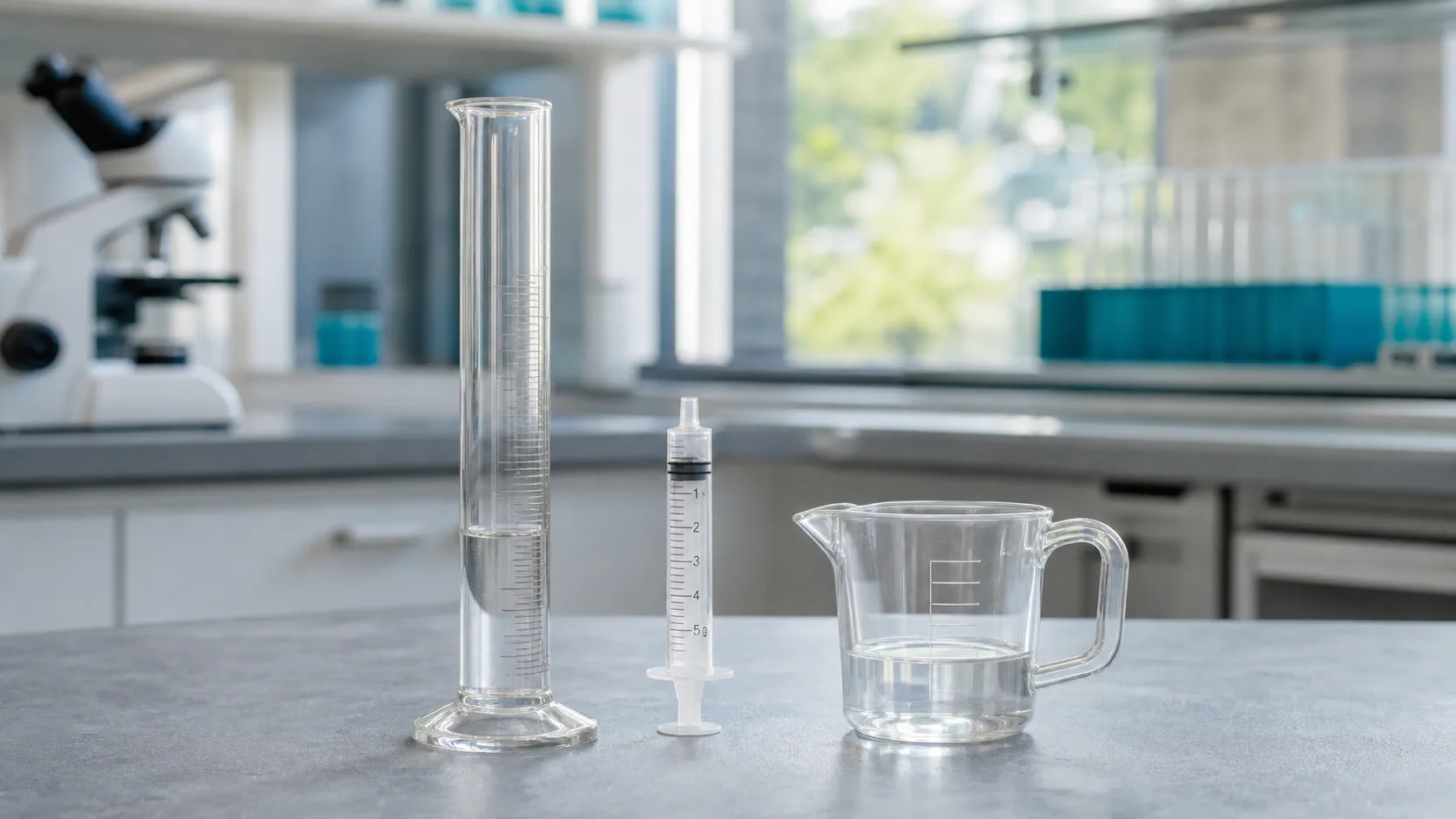
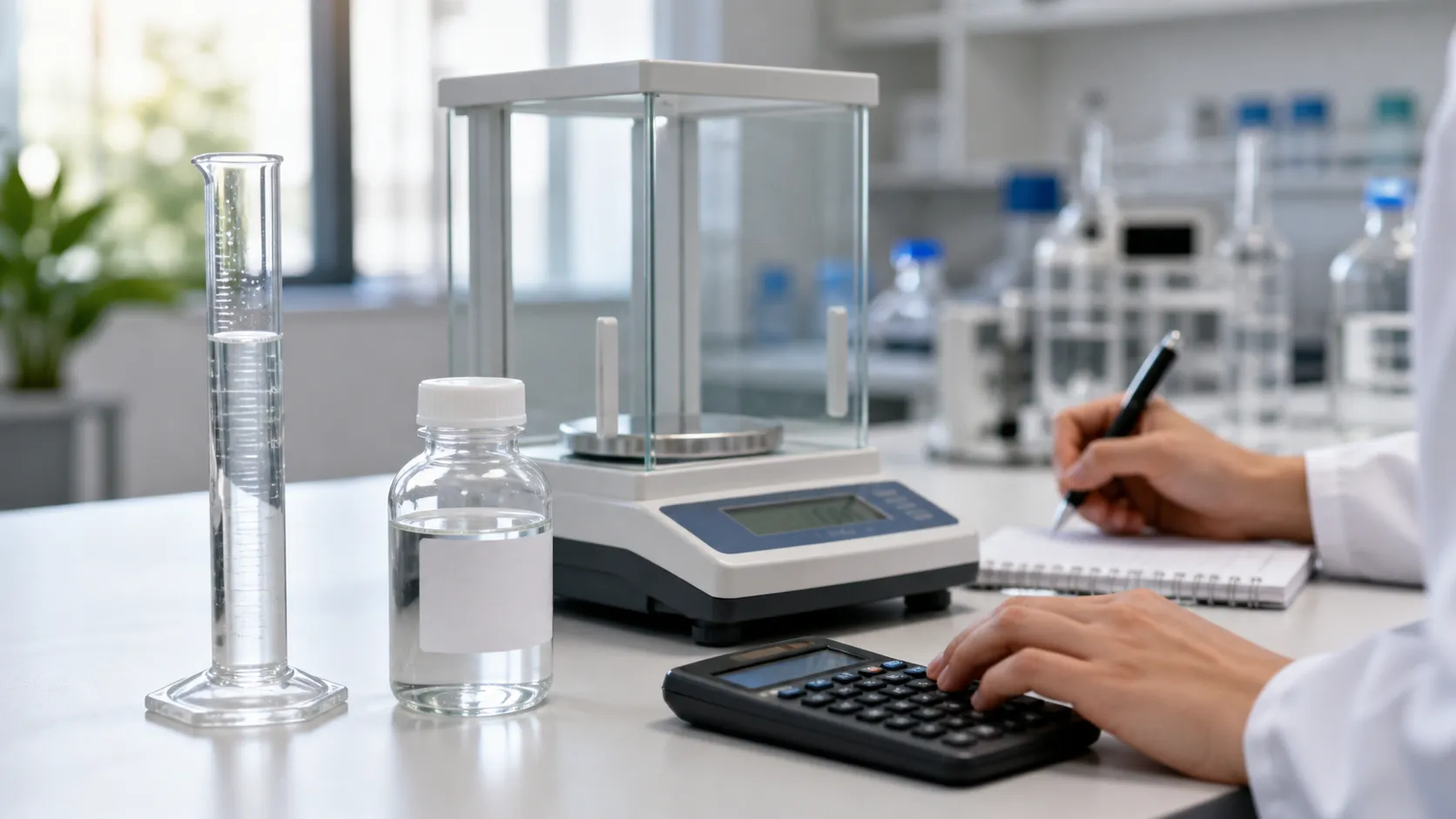
The difference between mg and mL is simple but important: milligrams measure mass, while milliliters measure volume. The two units are not equal and cannot be compared directly. To connect them, you need the substance’s density or, for liquid medicine, its concentration.
This distinction matters when reading prescriptions, supplement labels, laboratory instructions, and recipes. A label may state the amount of an active ingredient in mg while telling you to measure the liquid in mL. Confusing those values can produce a major measurement error. Understanding what each unit answers—“how much material?” versus “how much space?”—makes medicine labels and conversion formulas much easier to interpret.
Quick Comparison
| Feature | Milligram (mg) | Milliliter (mL) |
|---|---|---|
| Measures | Mass | Volume |
| Metric relationship | 1/1,000 of a gram | 1/1,000 of a liter |
| Answers | How much matter is present? | How much space does it occupy? |
| Common uses | Medicine strength, supplements, chemicals | Liquids, medicine volumes, laboratory solutions |
| Typical measuring tool | Scale or laboratory balance | Syringe, cylinder, pipette, measuring cup |
| Direct conversion possible? | Only with density or concentration | Only with density or concentration |
A milligram technically measures mass, even though it is often described casually as a unit of weight. A milliliter measures volume and can describe the space occupied by a liquid or solid.
Understanding the Difference Between mg and mL
The easiest way to separate the units is to look at the questions they answer.
A milligram tells you how much matter is present. If a tablet contains 500 mg of an ingredient, that number describes the ingredient’s mass. It does not tell you the tablet’s size or volume.
A milliliter tells you how much space something occupies. A medicine bottle might contain 100 mL of liquid. That figure describes the liquid volume, not the mass of the active ingredient inside it.
Both use the prefix “milli,” meaning one-thousandth, but they come from different base units:
- 1 mg = 0.001 g
- 1 mL = 0.001 L
- 1 g = 1,000 mg
- 1 L = 1,000 mL
Sharing the same prefix does not make the units interchangeable. A milligram is a fraction of a gram; a milliliter is a fraction of a liter.
What Does mg Measure?
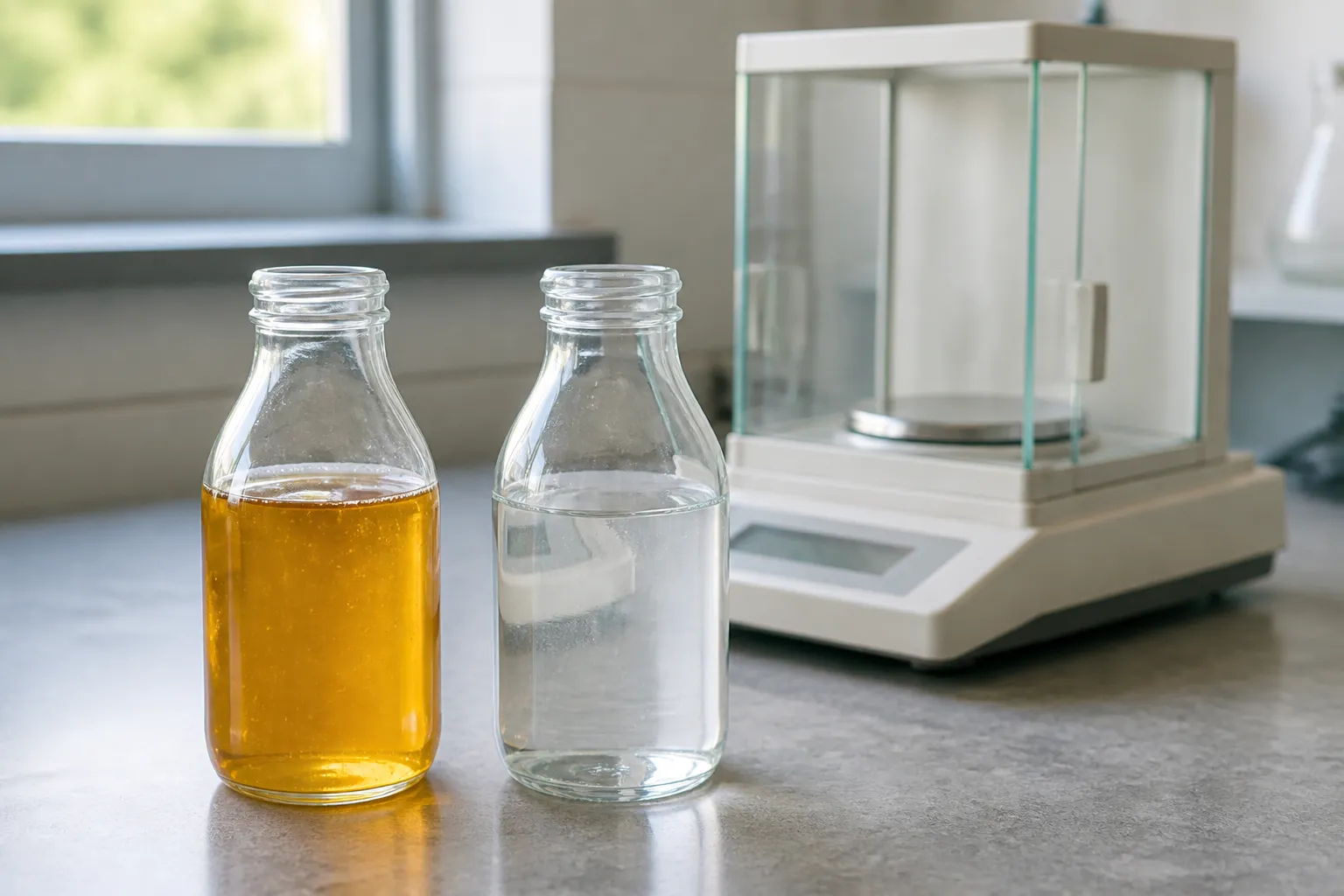
The abbreviation mg stands for milligram. It is a metric unit of mass used for quantities too small to express conveniently in grams.
Common examples include:
- active ingredients in tablets and capsules
- vitamins and minerals in supplements
- ingredients in liquid medicine
- laboratory chemicals
- small food components
- environmental contaminants
A tablet labeled 200 mg may contain 200 mg of its stated active ingredient. The complete tablet may have a greater total mass because it can also contain coatings, binders, coloring, or other inactive materials.
The mg meaning on a label therefore depends on the wording. It may refer to one active ingredient, the total mass of a sample, or the amount present in each serving. Always read what the number describes instead of assuming that it represents the entire product.
Mass is not exactly the same as weight
In everyday language, people often say that mg measures weight. Technically, it measures mass. Mass is the amount of matter in an object, while weight is the force produced by gravity acting on that mass.
An object’s mass remains the same in different gravitational conditions, even though its weight may change. For routine medication and household measurements on Earth, people commonly use “weight” informally, but “mass” is the more accurate term.
What Does mL Measure?
The abbreviation mL stands for milliliter. It measures volume—the amount of three-dimensional space occupied by something.
Milliliters commonly describe:
- water and beverages
- oral solutions and suspensions
- liquid supplements
- laboratory samples
- cosmetic products
- cooking ingredients
- container capacity
Although mL is strongly associated with liquids, volume is not limited to liquids. A milliliter can also describe the space occupied by a solid material. In practice, solids are more often measured by mass because particles, air gaps, and packing can make volume measurements less consistent.
One milliliter is equal to one cubic centimeter:
1 mL = 1 cc
It also contains 1,000 microliters:
1 mL = 1,000 µL
The symbols mL and cc therefore represent equal volumes, but neither one equals a fixed number of milligrams.
Why “Which Is Bigger, mg or mL?” Has No Direct Answer
Asking which is bigger, mg or mL, is like asking whether a minute is bigger than a meter. One measures time and the other measures length, so they cannot be ranked without changing the question.
The same principle applies to mg vs mL:
- mg belongs to the category of mass.
- mL belongs to the category of volume.
Five mg is not automatically more or less than 5 mL. The numbers may look alike, but they describe different properties.
For example, 5 mg might represent a small amount of an active ingredient dissolved in 1 mL, 5 mL, or 20 mL of solution. The answer depends on the solution’s concentration.
This is also why 5 mg does not equal 5 mL unless a specific material or solution happens to produce that relationship. The matching numbers alone prove nothing.
Density Connects Total Mass With Volume
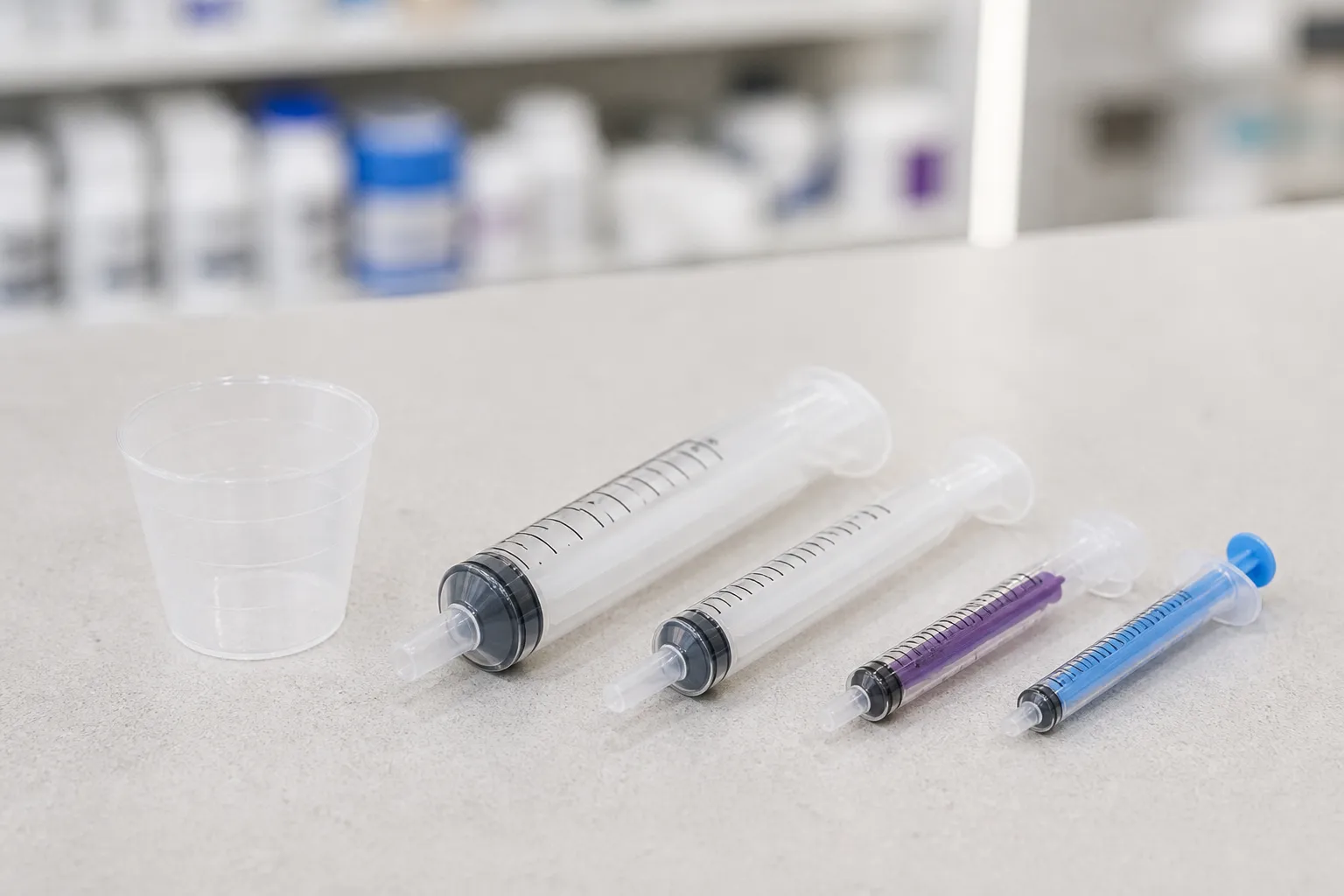
Density tells you how much total mass is packed into a given volume. It is commonly expressed in grams per milliliter or milligrams per milliliter.
For a pure substance or complete liquid:
Density = Mass ÷ Volume
Rearranging the formula gives:
Volume (mL) = Mass (mg) ÷ Density (mg/mL)
To convert in the other direction:
Mass (mg) = Volume (mL) × Density (mg/mL)
Suppose a liquid has a density of 800 mg/mL. The volume occupied by 400 mg is:
400 mg ÷ 800 mg/mL = 0.5 mL
If you have 2 mL of the same liquid:
2 mL × 800 mg/mL = 1,600 mg
These calculations refer to the total mass of the liquid, not merely one ingredient dissolved in it.
Why the answer changes by substance
A dense liquid packs more mass into each milliliter. A less-dense liquid contains less mass in the same volume.
This means:
- The same mass occupies less volume when density is higher.
- The same mass occupies more volume when density is lower.
- The same volume can have different masses depending on the material.
Temperature and composition can also affect density. Fixed conversions for oils, syrups, powders, and household products should not be used without checking the appropriate density.
The water relationship is only an example
Water has a density close to 1 g/mL, which is approximately 1,000 mg/mL under ordinary conditions. Therefore:
- 1 mL of water has a mass of approximately 1,000 mg.
- 1 mg of water occupies approximately 0.001 mL.
This relationship is useful for explaining mass vs volume, but it is not a universal rule. One milliliter of another material may contain more or less than 1,000 mg.
Concentration Connects an Ingredient With a Solution
Concentration is related to density, but the terms should not be treated as synonyms.
Density describes the total mass of a material per unit of volume. Concentration describes the amount of a specific ingredient in a volume of solution.
For instance, a liquid labeled 50 mg/mL contains 50 mg of the named ingredient in every 1 mL of liquid. The entire milliliter usually has a much greater total mass because it also includes water or another carrier, flavoring, preservatives, and additional ingredients.
This distinction matters whenever someone wants to convert mg to mL for medicine:
Volume required (mL) = Prescribed amount (mg) ÷ Concentration (mg/mL)
The concentration must come from the exact product label. Water density must not replace it.
The Difference Between mg and mL in Medicine
Medicine labels often show both units because each communicates different information:
- Dose is the amount of active ingredient intended for use, often written in mg.
- Strength describes how much active ingredient a dosage form contains.
- Concentration shows the amount of active ingredient per unit of liquid, such as mg/mL.
- Volume is the amount of liquid measured or administered, written in mL.
These terms are connected, but they are not interchangeable.
A prescription may specify an amount in mg, while the bottle gives a concentration in mg per 5 mL. The concentration is then used to determine the corresponding liquid volume.
Reading 250 mg per 5 mL
Suppose an oral solution or suspension is labeled:
250 mg/5 mL
This means:
- Each 5 mL contains 250 mg of the stated active ingredient.
- The liquid concentration is 50 mg/mL.
The concentration calculation is:
250 mg ÷ 5 mL = 50 mg/mL
If valid instructions require 100 mg, the corresponding volume would be:
100 mg ÷ 50 mg/mL = 2 mL
This is an example of interpreting concentration, not a recommendation that anyone should take 100 mg.
Why the same number of mg can require different volumes
Consider two liquid products:
| Product | Concentration | Volume containing 100 mg |
|---|---|---|
| Product A | 50 mg/mL | 2 mL |
| Product B | 25 mg/mL | 4 mL |
Both amounts contain 100 mg of active ingredient, but Product B requires twice as much liquid because its concentration is lower.
This is why the product name alone is not enough. Different formulations or reconstituted liquids may have different concentrations. The correct bottle and current label must be checked before measuring.
Safe Reading and Measuring of Liquid Medicine
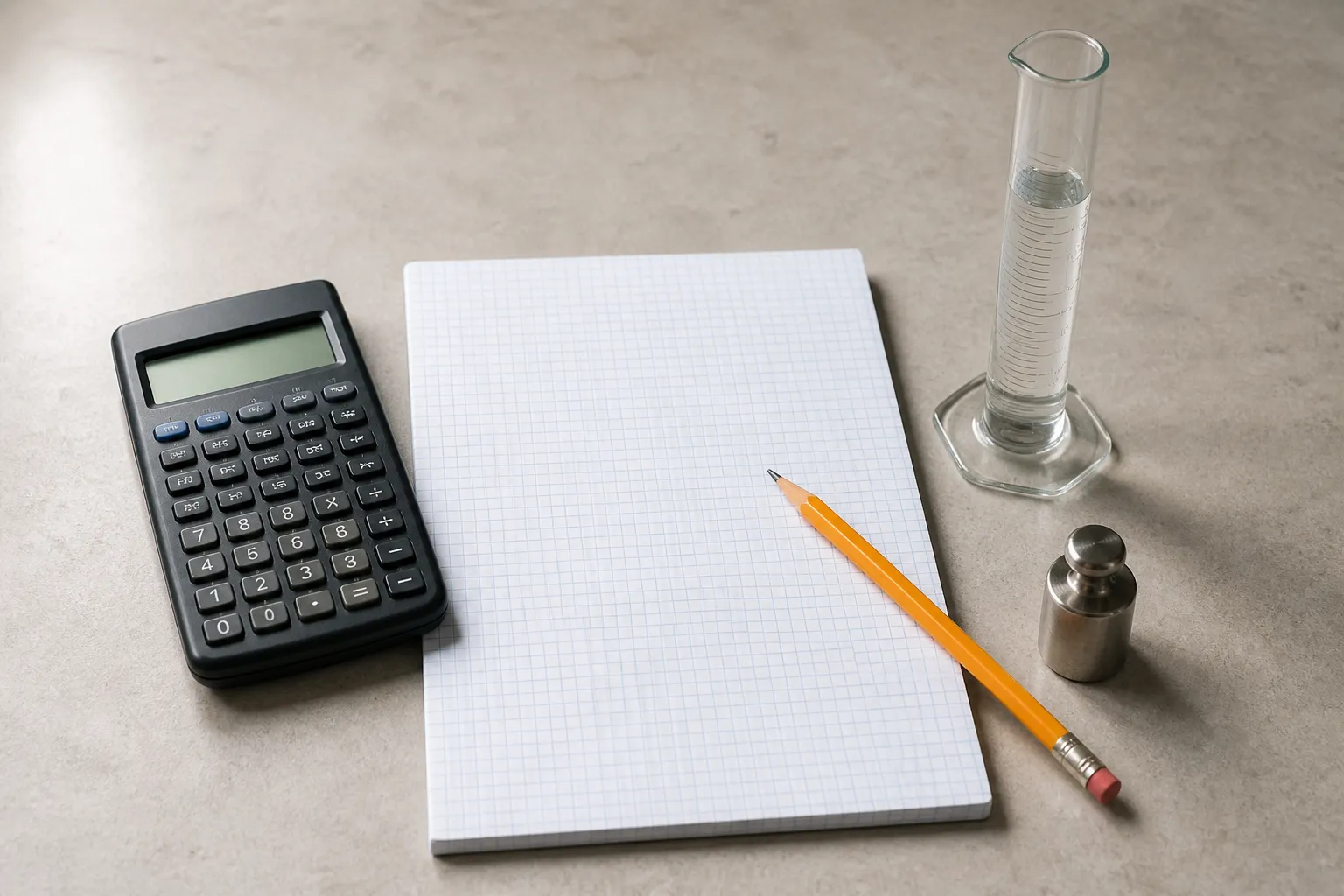
Confusing medicine strength with liquid volume can lead to a dosing error. The following checks reduce that risk:
- Confirm the medicine name and formulation.
- Read the concentration on the actual container.
- Verify whether the instructions use mg, mL, or another unit.
- Make sure the required amount and supplied concentration use compatible units.
- Calculate the liquid volume only when the prescribed amount is known.
- Use a calibrated oral syringe or another suitable measuring device.
- Ask a pharmacist or prescribing clinician to clarify anything uncertain.
A household teaspoon is not an ideal liquid dose measurement because its capacity may vary. Use the measuring device supplied with the medicine or one recommended by a healthcare professional.
Do not calculate a child’s dose from age alone. Pediatric instructions may depend on body weight, diagnosis, formulation, dosing limits, and other clinical factors.
Watch the decimal point
Small decimal errors can create large differences:
- 0.05 mL is one-tenth of 0.5 mL.
- 0.5 mL is one-half of 1 mL.
- 5 mL is ten times 0.5 mL.
Use a leading zero for values below one: write 0.5 mL, not .5 mL. In medication notation, unnecessary trailing zeros should be avoided because 1.0 mg could be misread as 10 mg if the decimal is overlooked.
Can mg and mL Be Converted?
Yes, mg and mL can be connected, but only when enough information is available.
To convert mg to mL
For the total mass of a substance:
mL = mg ÷ density in mg/mL
For an ingredient in a solution:
mL = required mg ÷ concentration in mg/mL
To convert mL to mg
For the total mass of a substance:
mg = mL × density in mg/mL
For an ingredient in a solution:
mg = mL × concentration in mg/mL
Without density or concentration, the calculation is incomplete. A statement such as “convert 20 mg to mL” cannot produce one dependable answer unless the substance or solution strength is also provided.
Common Misunderstandings to Avoid
“One mL always contains 1,000 mg”
That is approximately true for the total mass of water under ordinary conditions. It is not true for every material or for the active ingredient in every solution.
“One mg is always 0.001 mL”
Again, this is a water-specific approximation. The volume occupied by 1 mg changes with density.
“The mg number tells me how much liquid to measure”
The mg amount alone does not provide a liquid volume. You also need the product concentration.
“A medicine cup measures mg”
A medicine cup or oral syringe measures volume in mL. It measures an amount of active ingredient only indirectly when the liquid’s concentration is known.
“Two bottles of the same medicine always have the same concentration”
Product strengths can vary. Never transfer a volume instruction from one formulation to another without confirming the concentration.
Frequently Asked Questions
Is mg the same as mL?
No. A milligram is a unit of mass, while a milliliter is a unit of volume. They represent different physical quantities. Density or concentration is required to connect them mathematically.
Is 1 mg equal to 1 mL?
Not as a general rule. For 1 mg to be contained in 1 mL of a solution, that solution would need a concentration of 1 mg/mL. For total material mass, the relationship would depend on density.
How many mg are in 1 mL?
There is no fixed answer. One milliliter of water has a total mass of approximately 1,000 mg, while another substance may have a different mass. For medicine, check the labeled concentration, such as 25 mg/mL or 50 mg/mL.
What does mg per mL mean in medicine?
It describes concentration. For example, 20 mg/mL means every milliliter of liquid contains 20 mg of the stated active ingredient. It does not mean the entire milliliter of liquid has a total mass of only 20 mg.
Can I convert mg to mL without density?
You cannot convert the total mass of a material to volume without knowing its density. For a solution or liquid medicine, concentration can be used instead. Without either value, the conversion cannot be completed accurately.
Which is bigger, mg or mL?
Neither is inherently bigger. Milligrams measure mass and milliliters measure volume, so comparing them directly is not meaningful. A density or concentration must first establish a relationship between the two units.
What is the difference between dose and volume?
Dose generally refers to the intended amount of active ingredient, which may be stated in mg. Volume is the amount of liquid measured in mL. Concentration determines how much liquid contains the specified dose.
Is 1 cc the same as 1 mL?
Yes. One cubic centimeter equals one milliliter of volume. However, 1 cc does not equal a fixed number of milligrams. Its mass or active-ingredient content depends on density or concentration.
Remember Which Question Each Unit Answers
The difference between mg and mL becomes easier to remember when each unit is tied to a separate question: mg tells you how much mass is present, while mL tells you how much space is occupied.
Density connects the total mass of a material with its volume. Concentration connects the mass of a particular ingredient with the volume of a solution. For liquid medicine, rely on the exact labeled concentration, use a calibrated measuring device, and have unclear instructions checked by a pharmacist or prescribing clinician.
Convert mg and mL with the value that actually matters.
Use the calculator with your substance density or the exact concentration shown on the product label.

Misbah Shafique
Misbah Shafique creates clear, carefully researched guides about mass, volume, density, concentration, and everyday measurement conversions.